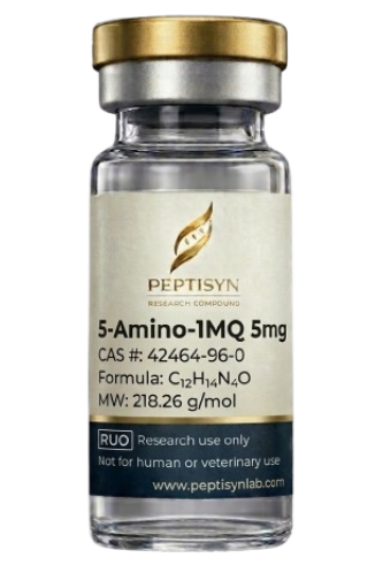
5-Amino-1MQ 5mg
A small-molecule selective inhibitor of nicotinamide N-methyltransferase (NNMT). Used in metabolism research as a tool to elevate intracellular NAD⁺ and SAM, and to investigate adipocyte and muscle bioenergetics.
- Class
- Small molecule (quinoline)
- Molecular Formula
- C10H13N5
- Molecular Weight
- 203.25 g/mol
- Purity
- ≥ 99% HPLC
- Vial Content
- 5 mg
- Form
- Lyophilized powder
Overview
5-Amino-1-methylquinolinium (5-Amino-1MQ) is a small-molecule selective inhibitor of NNMT — nicotinamide N-methyltransferase. NNMT is highly expressed in adipose tissue, liver and skeletal muscle, where it consumes nicotinamide (a NAD⁺ precursor) and S-adenosyl-methionine (SAM, a methyl donor). Inhibiting NNMT therefore conserves both substrates.
The compound is widely used as a metabolic-research tool to investigate energy expenditure, fat-cell biology, NAD⁺ homeostasis and methyl-group economy. It is one of the few selective NNMT inhibitors available in research-grade form.
Mechanism of Action — How It Works
The molecule competitively occupies the NNMT active site, preventing methylation of nicotinamide. Two metabolic pools are affected.
NAD⁺ Conservation
Nicotinamide (NAM) is a key salvage-pathway precursor of NAD⁺. By blocking its consumption by NNMT, intracellular NAD⁺ rises, supporting sirtuin and PARP activity.
SAM Conservation
Each NNMT methylation event consumes SAM. Inhibition preserves SAM, restoring methyl-group balance throughout the cell.
Adipocyte Energy Use
Reduced 1-methylnicotinamide output is associated with increased futile-cycle activity in adipocytes, raising basal energy expenditure.
Sirtuin Activation
The rise in NAD⁺ supports SIRT1/SIRT3 activity, which connects to mitochondrial biogenesis and metabolic-homeostasis pathways.
Research Effects on the Body
Endpoints reported in metabolism and aging research literature.
- Adipose tissue: reduced fat-cell expansion and increased energy expenditure in adipocyte-research models.
- Body composition: reductions in fat mass without significant lean-mass loss reported in animal studies.
- NAD⁺ levels: measurable elevation of NAD⁺ in target tissues.
- Skeletal muscle: investigated in models of sarcopenia and age-related muscle decline.
- Insulin sensitivity: improvements in glucose-metabolism markers in metabolic models.
- Liver: reduced hepatic lipid accumulation in NAFLD-style research models.
Reconstitution — Dilution Math
5-Amino-1MQ is supplied as a lyophilized powder. Reconstitute with bacteriostatic water. Volumes shown for the 5 mg vial — units refer to insulin syringe (1 mL = 100 IU).
| Bac Water | Concentration | 50 mg dose* | 100 mg dose* | 150 mg dose* |
|---|---|---|---|---|
| 1 mL | 5 mg/mL | 0.01 mL · 1 IU = 50 mcg | 0.02 mL · 2 IU = 100 mcg | 0.03 mL · 3 IU = 150 mcg |
| 2 mL | 2.5 mg/mL | 0.02 mL · 2 IU | 0.04 mL · 4 IU | 0.06 mL · 6 IU |
| 0.25 mL | 20 mg/mL | 0.0025 mL | 0.005 mL | 0.0075 mL |
Dosing Reference (Research Context)
Ranges below are from peer-reviewed NNMT-inhibition research.
| Phase | Reported Range (animal mg/kg) | Frequency | Notes |
|---|---|---|---|
| Low | 5 mg/kg | Once daily | Initial titration in rodents |
| Mid | 10 mg/kg | Once daily | Most common research dose |
| High | 20 mg/kg | Once daily | Upper end of published research |
Half-Life, Onset and Duration
Half-life: approximately 3 – 4 hours (short).
Onset: NNMT inhibition is immediate at the enzyme level; downstream NAD⁺ rise is observable within hours of administration.
Duration of effect: covers most of the day with once-daily dosing in research models. Effects on adipose tissue and energy expenditure accumulate over multiple weeks.
Wash-out: systemic clearance within 24 hours; metabolic effects regress over 1 – 2 weeks of discontinuation.
Storage & Stability
- Lyophilized vial: store at −20 °C for long-term stability. Refrigeration (2–8 °C) acceptable for short-term storage.
- Reconstituted solution: store at 2–8 °C; use within 28 days.
- Light: protect from direct light.
- Form note: small molecule — solubility in aqueous buffers is high.