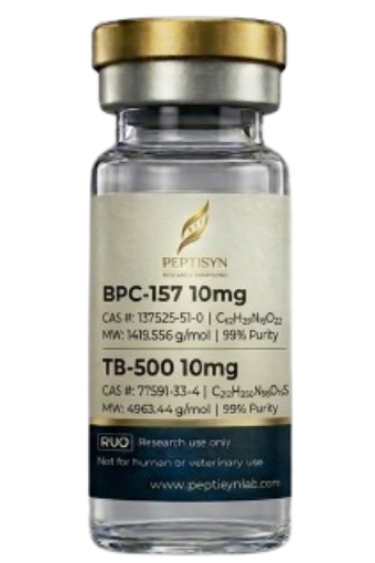
BPC-157 10mg + TB-500 10mg
Co-lyophilized blend of two complementary regenerative peptides. BPC-157 (Body Protective Compound) drives angiogenesis and tissue repair; TB-500 (Thymosin β-4 fragment) mobilizes G-actin for cell migration. Together they form the most referenced research blend for tissue-repair studies.
- Vial Content
- 20 mg total · 10 mg + 10 mg
- BPC-157
- Pentadecapeptide · 1419.55 g/mol
- TB-500
- Tβ4-fragment · ~4963 g/mol
- Purity
- ≥ 99% HPLC
- Form
- White lyophilized powder
- Class
- Regenerative blend
Overview
This dual-compound research vial pairs BPC-157, a 15-amino-acid sequence derived from a gastric protective protein, with TB-500, the active fragment of Thymosin β-4. The two peptides are widely characterized in regenerative-research literature for their additive effects on healing, angiogenesis and cell migration.
BPC-157 is a partial sequence of the human gastric juice "body protective compound." It is stable in gastric environments and used in research on connective tissue, vascular and gastrointestinal repair.
TB-500 corresponds to the LKKTETQ-containing fragment of Thymosin β-4 — the principal G-actin-sequestering protein in mammalian cells. It modulates cytoskeletal dynamics, supporting cell migration to injury sites.
Mechanism of Action — How It Works
The two peptides target complementary pathways. BPC-157 acts on growth-factor cascades and nitric-oxide signaling; TB-500 modulates the actin cytoskeleton and inflammatory signaling. The combined profile is broader than either alone.
BPC-157 — Angiogenesis
Upregulates VEGFR2 expression, promoting formation of new capillaries in damaged tissues and improving local blood supply.
BPC-157 — NO Pathway
Modulates the nitric-oxide system to support endothelial function and protect against ulceration in research models.
TB-500 — Actin Mobilization
Sequesters G-actin monomers, regulating cytoskeleton turnover and enabling rapid cell migration to sites of damage.
TB-500 — Inflammation
Modulates inflammatory signaling and supports differentiation of progenitor cells into reparative phenotypes.
Research Effects on the Body
Endpoints reported across regenerative-research literature.
- Tendon and ligament repair: accelerated healing in animal models of tendinopathy and partial tear.
- Muscle recovery: faster restoration of contractile function following research-induced injury.
- Gastrointestinal protection: BPC-157 reduces lesions in gastric and intestinal injury models.
- Vascular regrowth: documented angiogenic response in ischemic and wound models.
- Connective-tissue support: improved fibroblast activity and collagen organization.
- Inflammation modulation: reduced pro-inflammatory signaling at injury sites.
Reconstitution — Dilution Math
The 20 mg blend (10 mg BPC-157 + 10 mg TB-500) is reconstituted with bacteriostatic water. Each volume below splits proportionally between the two peptides. Units refer to insulin syringe (1 mL = 100 IU).
| Bac Water | Total Concentration | Per peptide | 500 mcg blend | 1 mg blend |
|---|---|---|---|---|
| 1 mL | 20 mg/mL | 10 mg/mL each | 0.025 mL · 2.5 IU | 0.05 mL · 5 IU |
| 2 mL | 10 mg/mL | 5 mg/mL each | 0.05 mL · 5 IU | 0.10 mL · 10 IU |
| 4 mL | 5 mg/mL | 2.5 mg/mL each | 0.10 mL · 10 IU | 0.20 mL · 20 IU |
Dosing Reference (Research Context)
Dose ranges from regenerative-peptide research literature, listed for laboratory reference only.
| Phase | Reported Range | Typical Frequency | Vial Duration (20 mg) |
|---|---|---|---|
| Maintenance | 250 – 500 mcg blend | Once daily | 40 – 80 days |
| Active repair | 500 mcg – 1 mg blend | 1–2× daily | 10 – 40 days |
| Loading phase | 1 – 2.5 mg blend | Twice weekly | 4 – 10 weeks |
Half-Life, Onset and Duration
BPC-157: short plasma half-life (~4 hours) but research literature describes a tissue effect that significantly outlasts circulating levels.
TB-500: moderate half-life of several hours; protocols typically space larger doses 2–3 days apart.
Onset: early effects observable within days in tissue-repair models.
Duration of effect: reparative outcomes accumulate over multi-week research courses.
Storage & Stability
- Lyophilized vial: store at −20 °C for long-term stability. Refrigeration (2–8 °C) acceptable for short-term storage.
- Reconstituted solution: store at 2–8 °C; use within 21 – 28 days.
- Light: protect from direct light.
- Handling: swirl gently to dissolve; do not shake aggressively.