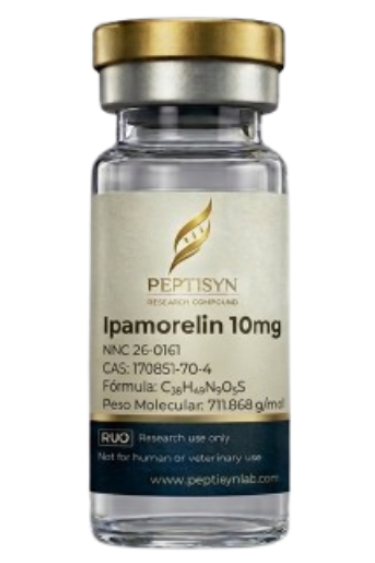
Ipamorelin 10mg
A pentapeptide ghrelin-receptor agonist (GHRP) acting selectively on the GHS-R1a receptor of the pituitary. Cleanest of the GHRP class — produces a pulsatile GH release without significant cortisol or prolactin elevation.
- CAS Number
- 170642-56-1
- Molecular Formula
- C50H69N11O9
- Molecular Weight
- 959.14 g/mol
- Purity
- ≥ 99% HPLC
- Vial Content
- 10 mg lyophilized
- Length
- 5 residues
Overview
Ipamorelin is a five-residue synthetic peptide and a selective growth-hormone-releasing peptide (GHRP). Among the GHRP class — which includes GHRP-2 and GHRP-6 — ipamorelin is regarded as the cleanest, producing a pulsatile GH release without notable elevation of cortisol, prolactin or aldosterone.
Sequence: Aib-His-D-2-Nal-D-Phe-Lys-NH₂. The molecule mimics ghrelin's interaction with the GHS-R1a receptor on pituitary somatotrophs, triggering a discrete GH pulse. It is most often combined with a GHRH analog (such as tesamorelin, sermorelin or CJC-1295) in research protocols, where the two pathways act synergistically.
Mechanism of Action — How It Works
Ipamorelin acts as a ghrelin-receptor agonist, distinct from but complementary to GHRH-receptor agonists.
GHS-R1a Activation
Mimics ghrelin to activate the GHS-R1a (growth-hormone-secretagogue) receptor on pituitary somatotrophs, triggering GH release.
Pulsatile GH Release
The release pattern mimics endogenous physiological GH pulses — short and dose-proportional, returning to baseline within hours.
Selective Profile
Unlike older GHRPs, ipamorelin does not significantly stimulate cortisol, prolactin or aldosterone, making it the cleanest pulsatile-GH research tool.
Synergy with GHRH
When combined with GHRH analogs in research, the two pathways converge on somatotrophs producing a larger, summated GH pulse than either alone.
Research Effects on the Body
Endpoints reported in GH-axis research literature.
- GH pulse amplitude: a discrete and reproducible rise in plasma GH within 30 minutes.
- IGF-1 elevation: mild-to-moderate rise with consistent multi-week dosing.
- Lean tissue: investigated in research on muscle preservation and post-injury recovery.
- Recovery / sleep: overlap with the natural nocturnal GH-pulse profile in GH-axis studies.
- Bone: investigated for bone-mineral-density endpoints in GH-axis models.
- Cortisol / prolactin: negligible effect, contrasting with older GHRP research peptides.
Reconstitution — Dilution Math
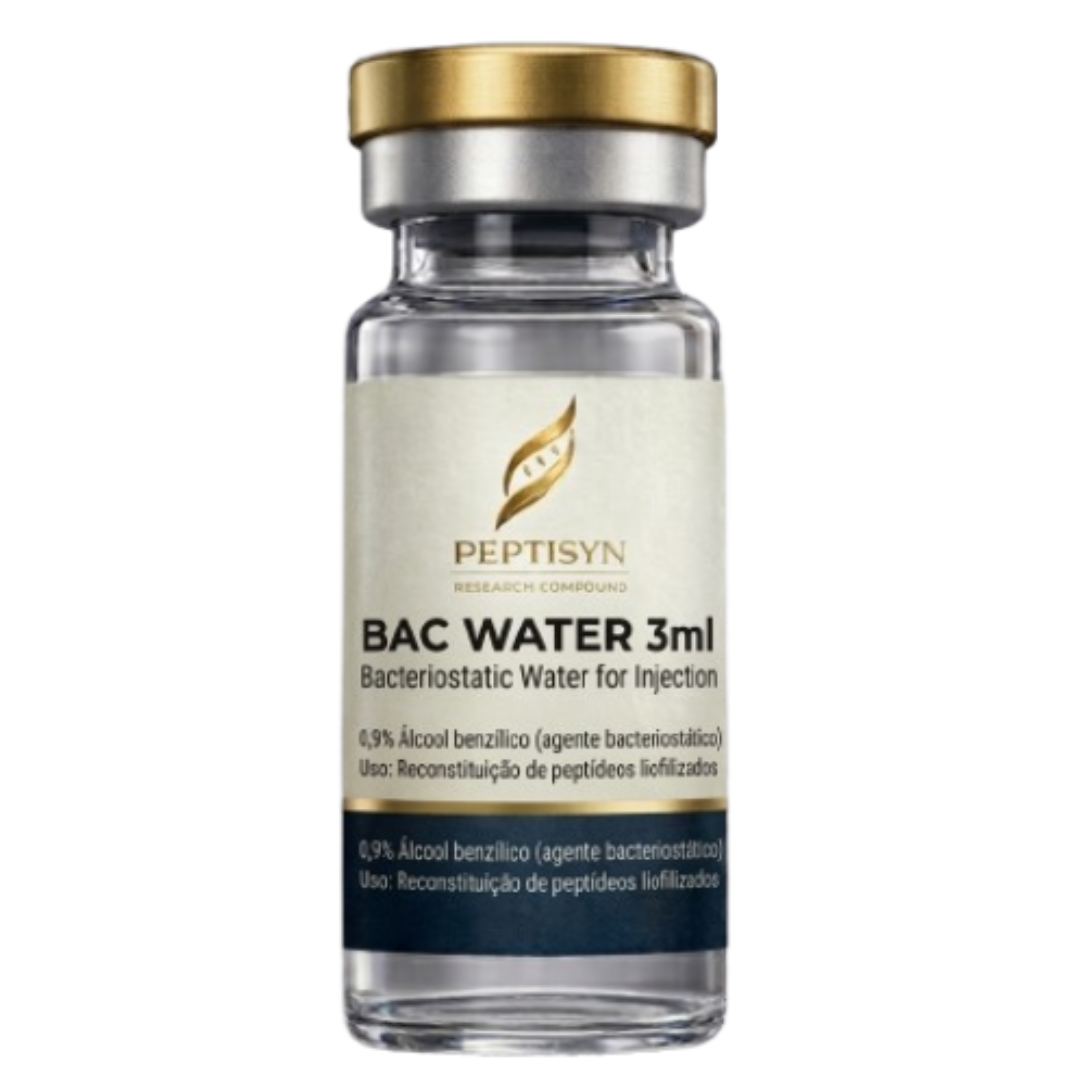
Ipamorelin is supplied lyophilized. Reconstitute with bacteriostatic water. Volumes shown for the standard 10 mg vial — units refer to insulin syringe (1 mL = 100 IU).
| Bac Water | Concentration | 100 mcg dose | 200 mcg dose | 300 mcg dose |
|---|---|---|---|---|
| 0.5 mL | 20 mg/mL | 0.005 mL · 0.5 IU | 0.01 mL · 1 IU | 0.015 mL · 1.5 IU |
| 1 mL | 10 mg/mL | 0.01 mL · 1 IU | 0.02 mL · 2 IU | 0.03 mL · 3 IU |
| 2 mL | 5 mg/mL | 0.02 mL · 2 IU | 0.04 mL · 4 IU | 0.06 mL · 6 IU |
Dosing Reference (Research Context)
Ranges below are typical of GHRP research protocols, listed for laboratory reference only.
| Phase | Reported Range | Typical Frequency | Vial Duration (10 mg) |
|---|---|---|---|
| Low | 100 mcg | Once daily | ~100 days |
| Standard | 200 – 300 mcg | 2 – 3× daily | ~17 – 50 days |
| Higher | 500 mcg | 2 – 3× daily | ~6 – 10 days |
Half-Life, Onset and Duration
Half-life: approximately 2 hours.
Onset: a pulsatile GH rise begins within 15 – 30 minutes of administration.
Duration of effect: the GH pulse lasts roughly 2 – 3 hours per dose. Multi-day downstream effects on IGF-1 accumulate over weeks of consistent dosing.
Wash-out: clearance within 8 – 12 hours; downstream IGF-1 effects regress over 1 – 3 weeks of discontinuation.
Storage & Stability
- Lyophilized vial: store at −20 °C for long-term stability. Refrigeration acceptable for short-term storage.
- Reconstituted solution: store at 2–8 °C; use within 28 days. Do not freeze after reconstitution.
- Light: protect from direct light.
- Handling: gentle swirl only; do not shake.